
Lightyear Frontier Crop Rotation: Soil Pairings
Plan crop rotation with a clear soil-pairing table, check the planting preview and keep useful harvests flowing through your farm.
Rotate by crop family and mound type
Crop rotation depends on the family of the seed and the type of mound. Repeating the same crop is easy to remember, but changing families can produce a different harvest outcome. In 1.0, check the planting preview before committing a whole field.
Do not treat real-world fertilizer logic as the rule here. A matching crop and soil name is not automatically the bonus combination you want.
The soil-pairing reference
The established interaction table is:
| Seed family | Soil for high yield | Soil for mutation |
|---|---|---|
| Nitrogenic | Phosphoric | Potassic |
| Phosphoric | Potassic | Nitrogenic |
| Potassic | Nitrogenic | Phosphoric |
A mound takes the type of the crop that matures in it. Plan the next planting around that resulting soil, not just the field's original appearance. If a current planting preview disagrees with a remembered table, stop and check the selected seed and mound before scaling up.
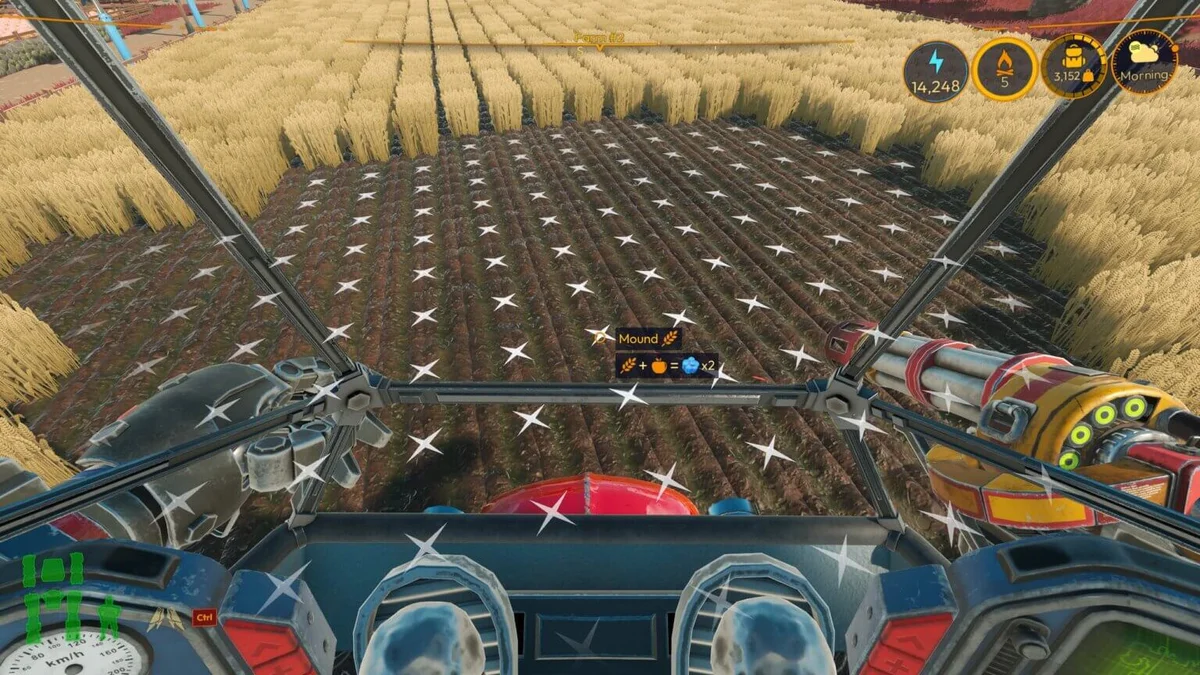
Design a rotation you can maintain
Choose one crop from each family that serves a current purpose. Then use the table to select the next family after each harvest. You do not need six enormous fields before the system becomes useful; a small labeled test area is enough to establish the sequence.
Keep a field note with three entries: what just matured, the soil it left, and what you will plant next. This avoids confusing a future plan with the crop already in the ground.
Separate the desired outcome from the crop name
A delivery asking for a mutated product and a machine requiring an ordinary crop can draw on different parts of your harvest. In 1.0, a mutated harvest also includes normal produce, which makes the outcome less disruptive. Still, plan around the item the recipe actually accepts rather than assuming every variant is interchangeable.
Mulch changes mound type. Fertilizer improves yield without changing that type. Use mulch when you need to redirect the rotation; use fertilizer when the pairing is already right and you want more output.
Expand after one reliable cycle
Finish a complete cycle in a manageable area before copying it across the farm. Check seed reserves, watering time, storage and the next delivery's requirements. More planting space helps only when the whole cycle remains workable.
Use the crop chart to choose families, soil types to reset a field, or mutated crops for a targeted mutation plan.